On 10 December 2025, the ISSF announced the rule changes for 2026. In this context, an accompanying letter to the national federations was published, dated 7 December 2025, clearly stating that the rules are intended to enter into force on 1 January 2026 and that the attached document is a draft intended for information and distribution to subordinate stakeholders.
The published changes are designated as a DRAFT on the ISSF website. Prior to this, there had already been some information circulating regarding clothing regulations in the rifle disciplines. The upcoming changes to the final formats were also foreseeable.
What came as a surprise, however, were the significant rule changes concerning pistol grips for the 10 m and 25 m events, which had not reached us in advance.
The new rules can be found starting with Rule 8.4.1 here:
Below is the excerpt including Rule 8.4.1:
In detail, the following rules for 10m Air Pistol and 25m Pistol have been newly added, supplemented, or amended:
1. Clarification: wrist must remain visibly free (Rule 8.4.1.1 letter a, sentence 3)
Even in the previous version of the rules, it was already stipulated that the wrist must remain visibly free when holding the pistol in the normal firing position. In the new rules applicable from 2026, it is now explicitly clarified that the wrist being free must be clearly and visibly recognisable without any marking of the athlete’s hand.
2. No compressible materials on the grip
This is not a new finding. The addition clarifies that soft foams, such as rubber foam, must not be used. Whether an increase of the palm shelf made of cork is still permissible remains unclear. It is difficult to assess precisely where “compressible material” begins.
3. No upward support of the hand in the transverse direction
Until now, the note that the grip must not provide any support to the hand beyond 90° in the transverse direction was only included in the pistol specification table (letter a) under Rule 8.11. This provision has now also been incorporated into Rule 8.4.1.5, letter c (10m Air Pistol) and, with identical wording, into Rule 8.4.1.6, letter c (25m Pistol).
The drawings previously found under Rule 8.1.3 are now located under Rule 8.4.1.1.
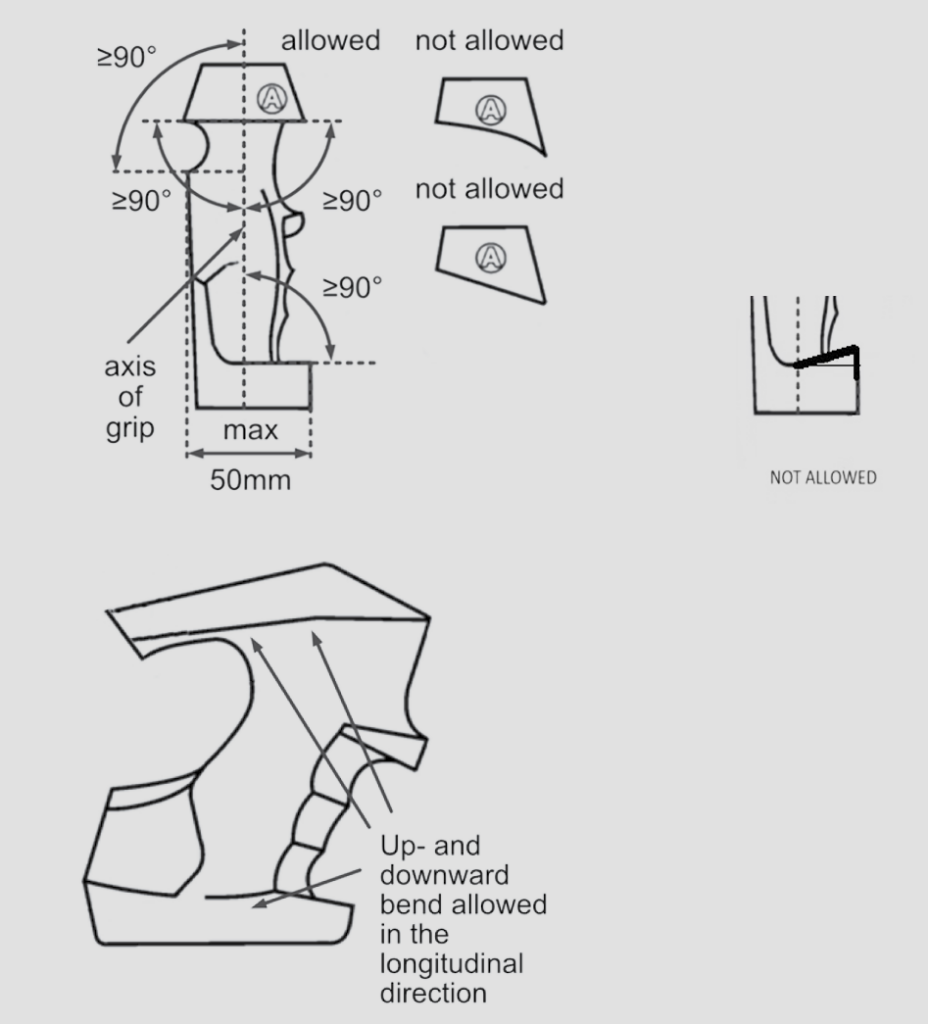
These have been supplemented by an additional drawing on the right-hand side. Only this drawing makes it clear that the 90° referenced in Rules 8.4.1.5 c and 8.4.1.6 c is to be understood in relation to the grip axis.
Unfortunately, the ISSF has failed to define the ambiguous term grip axis. From the drawing, one might assume that the grip axis refers to a vertical line extending from the upper edge of the grip as seen from the rear. In practice, however, this is not a suitable reference, since the two upper sides of a grip do not necessarily have the same height.
In other words: the axis could be freely defined depending on the design of the grip’s upper contour and would therefore be almost arbitrary.
Interpreting the grip axis as a vertical line originating from any edge of the pistol is equally unsuitable.
Interpreting the grip axis as a vertical line originating from any edge of the pistol is equally unsuitable.
If, for example, the lower edge of the rear sight or another horizontal part of the pistol were used as the reference axis, this would result in grips with lateral angle adjustment having the palm shelf standing well above 90°.
In this respect, the newly added drawing on the right can be understood as a clarification that this exact interpretation is not intended. A grip does not become non-compliant simply because the pistol is laterally tilted within the grip, for example to compensate for canting.
Nevertheless, the question of how the grip axis is to be defined remains unresolved.
4. No upward support of the thumb ball in the longitudinal direction
Previously, supports in the longitudinal direction of the grip were not restricted. The former rule in the table under Rule 8.1.2 letter a, last sentence, explicitly permitted this. This sentence has now been transferred almost verbatim (except for an added “The” at the beginning) into Rule 8.4.1.5 letter g and Rule 8.4.1.6 letter g.
What is new is the provision that, contrary to the above rule, this no longer applies to the thumb ball towards the rear of the grip. This is regulated by the new Rule 8.4.1.5 letter f and Rule 8.4.1.6 letter f, which prohibit the grip from rising again in the longitudinal direction at the rear end after the lowest point. The reference for the lowest point is the barrel axis.
To clarify what is meant, the ISSF has included sketches for both rules. Shown here is the sketch from Rule 8.4.1.6:
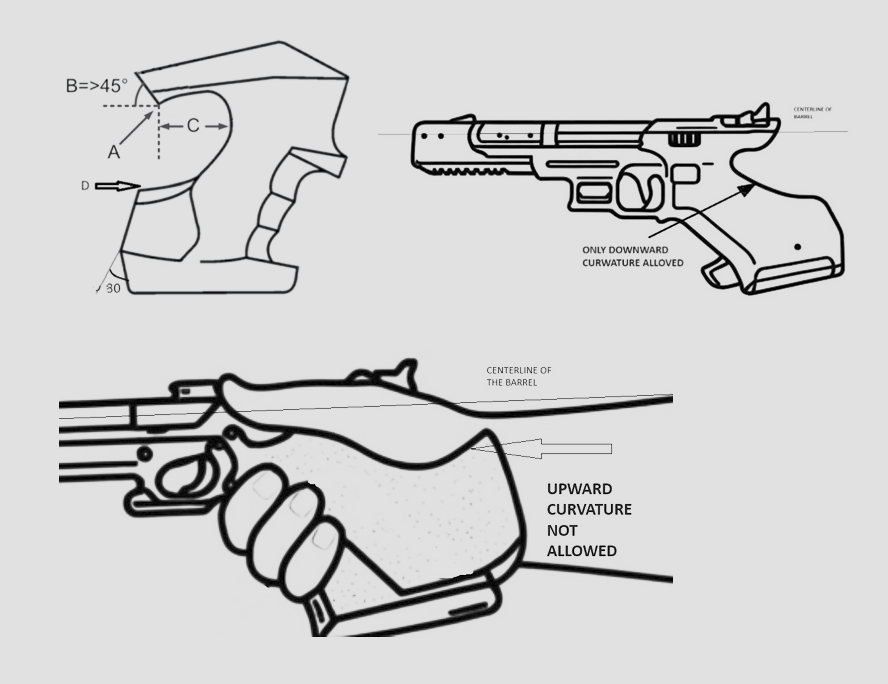
This effectively means that the so-called “Schumann hook” (named after three-time Olympic champion Ralf Schumann, marked by an arrow at the bottom of the sketch) will no longer be permitted in the future.
Many modern air pistols allow the angle of the pistol within the grip to be adjusted in the longitudinal direction. Grips must comply with the new thumb-ball rule even when this angle is set completely flat by the shooter.
5. Palm rest (heel rest) must have a 30° angle at the rear end
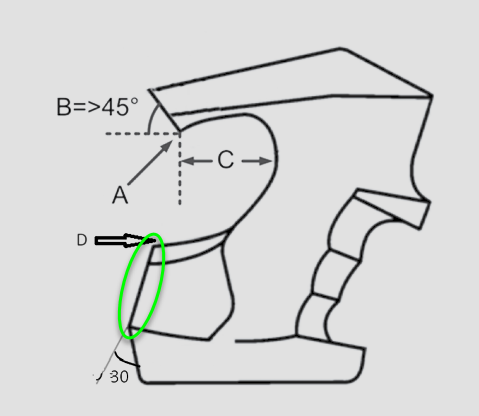
Rule 8.4.1.5 letter d and Rule 8.4.1.6 letter d require that the palm rest must have an angle of 30° or more at its rear end. This angle is to be measured from a vertical line passing through the rear end of the palm rest.
For this purpose, the previously used side-view sketch of the grip has been supplemented with the 30° angle (see illustration above). Unfortunately, even the sketch does not clearly indicate what the term perpendicular refers to. A reference dimension is simply missing.
Without a reference axis or surface, the term “perpendicular” remains undefined. The barrel axis, which would in principle be a suitable reference, is clearly not intended. If it were, the drawing would not make sense, as the barrel axis would then be depicted as pointing significantly downward.
One might infer from the sketch that the rear edge of the grip is intended as the reference axis. However, this option must also be dismissed. The line marking the angle is not an extension of that edge. Moreover, this would not work in practice either, as this edge is not mandatory in grip design; this part of the grip may also be rounded.
Until we gain clearer guidance, we will assume that the surface of the palm rest itself is the reference for the 30° angle. At present, this appears to us to be the most plausible interpretation.
6. rear grip extension for Air Pistol limited to 40 mm
Previously, a comparable rule limiting the length of the rear grip extension (the rear part of the frame or grip which rests on top of the hand between the thumb and the forefinger) to 30 mm existed only for 25 m pistols. This rule is now found under Rule 8.4.1.6 letter e.
A corresponding rule has now also been introduced for Air Pistol, with a maximum length of 40 mm, under Rule 8.4.1.5 letter e.
The additional requirement that the rear end of this part must be cut at an angle of 45° (see sketch above, letter B), measured from the barrel axis, already existed and is now also included in the Air Pistol regulation.
It is not clearly defined whether point A in the sketch may be an edge or also a rounded contour. From an ergonomic perspective, a rounded shape would certainly be more comfortable.
Summary
From the changes, it can be inferred that the requirement that a grip must under no circumstances provide a supporting function to the forearm, and that this must be recognisable at first glance without discussion or anatomical examination by the jury, has gained importance. The limitation of the rear grip extension to 40 mm can also be understood in this context.
The new regulation prohibiting the rearward enclosure of the thumb ball (the so-called Schumann hook) may also be seen in this context. From our perspective, however, this does not make sense and leads to practical problems due to the adjustability of grip angles.
The introduction of the 30° angle at the palm rest can be associated with the above-mentioned goal of making the free wrist more clearly recognisable. The rear upper end then appears slimmer and may be easier to assess visually. From a technical standpoint, the ISSF still needs to improve this point and define a clear reference dimension for the angle.
We would have wished—for ourselves, as well as for athletes and support staff—for a transition period that would have softened the introduction of the rules on 1 January 2026.
At the national level in Germany, the new regulations will likely be discussed at the next meeting of the Technical Commission. It is not expected that the rules will be adopted into the national rulebook for the 2026 competition year.
In the interest of grassroots sport, we would welcome it if this situation were to remain unchanged at the national level for the foreseeable future.
We are, of course, happy to support our internationally active customers with advice and practical assistance in adapting their grips to the new rules.